A Computer Can Never Be Held Accountable
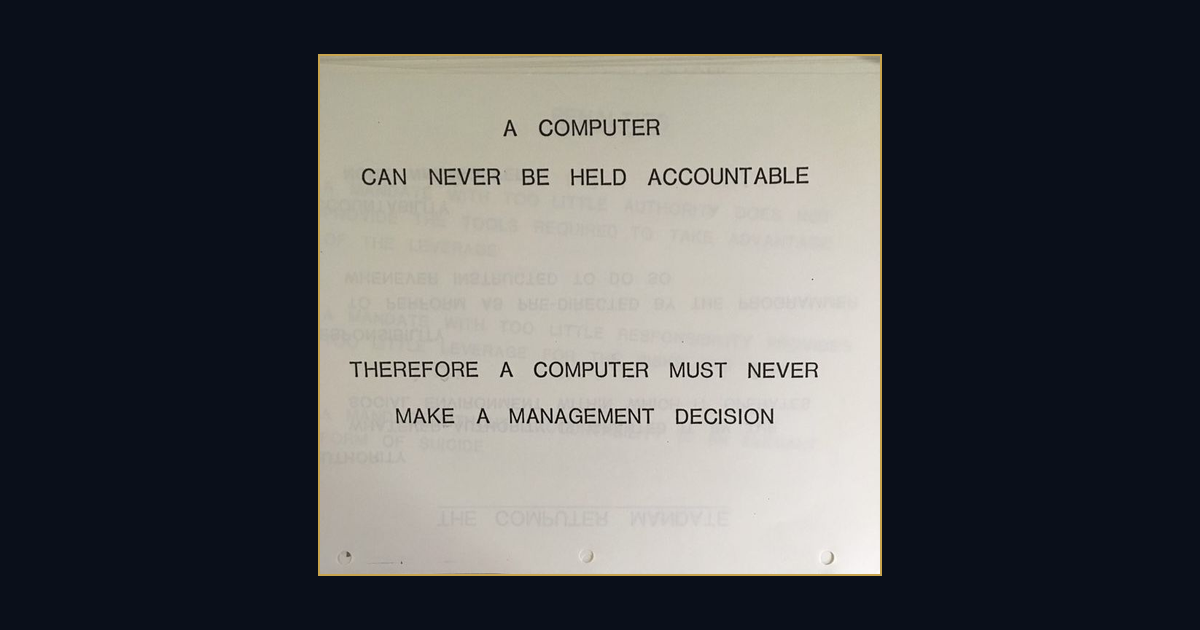
In 1979 IBM put up a typewritten slide in an internal training session. A sheet with three holes punched for the binder. On it were two sentences:
A computer can never be held accountable. Therefore a computer must never make a management decision.
I am going to take it as true. IBM, 1979. The paper trail behind the photograph is thin and the original is gone, but I take it at its word, because the weight is not in who said it but in what it says. And that holds either way.
It isn't an aphorism. It's an argument.
Most people quote the sentence as a point and stop there. But on the back of the photographed sheet, the text from the next page shows through. Pulled forward, it reveals that the sentence is the conclusion of an argument, not a punchy line standing alone.
The next page is headed THE COMPUTER MANDATE, and it defines a management mandate in three parts: authority, responsibility and accountability.
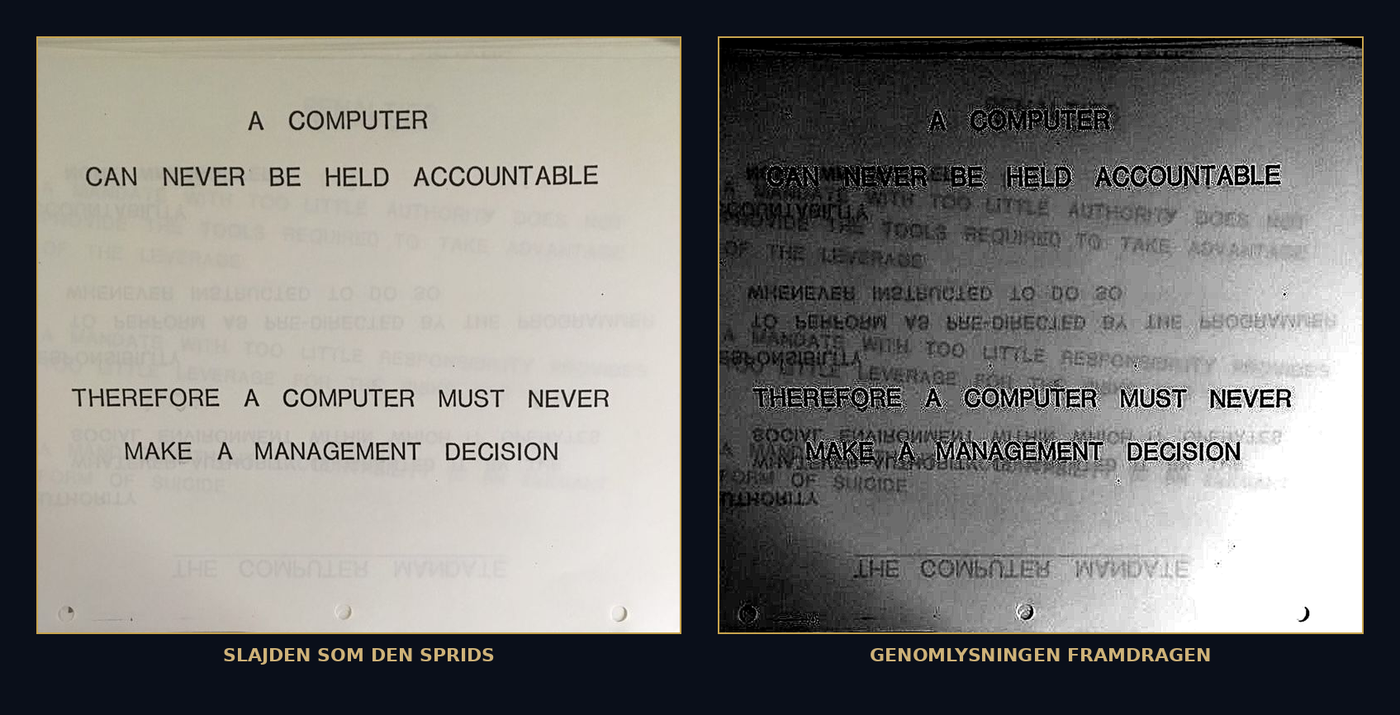
The handout puts a value on each of the three terms. On the third, accountability, sits the line the whole slide turns on, printed in capitals: none whatsoever. Applied to a computer, the answer is exactly that.
So the argument is not that computers are unreliable. It is that the capacity to be held accountable is a precondition for holding a mandate at all. An actor that cannot bear it cannot hold the mandate. However good its judgment may be.
That is why the argument does not age
This is the decisive difference. Most objections to letting machines decide are built on capability. The model hallucinates. The model lacks context. The model misses the nuance. Every one of those objections weakens with each new model, because capability actually grows.
IBM's argument does not. It does not care about capability. It says that accountability is not a property you can get good enough to be exempt from. A computer that becomes twice as capable does not become half as accountable. It becomes exactly as unaccountable as before, because it still cannot bear the consequence of having been wrong.
That is why a sentence from the late seventies still bites. It never described the limits of the technology. It described the nature of accountability.
What they saw coming
The same handout lists what it called travesties. Confusions to avoid. Two of them stand out: the computer as manager, the computer as god.
They did not foresee a model architecture. They foresaw a confusion. That one day someone would quietly swap out the one who bears the decision for the thing that computes it. And they put words to why that is a category error, not an efficiency choice.
That is exactly the confusion I live to avoid. AI is part of everything I deliver. But the decision to press enter is mine, every time, because my name is on what gets sent. Accountability cannot be delegated to a tool, however good the tool becomes. That is not a technical stance. It is what a mandate means.
The machine moved everywhere except here
Since 1979 the machine has gotten better at almost everything. It writes, it computes, it codes, it summarises a meeting before you have left the room. On the one thing that decides whether it may hold a mandate, it has not moved a millimeter.
IBM was right, and right for a reason that does not wear out. Accountability is constitutive of a mandate, an actor that cannot bear accountability cannot hold a mandate, a computer cannot bear accountability. The rest follows. It held when the page was written. It holds more now, not less.