Reflections
What I actually think
On AI-first delivery, technology strategy, and what happens when expertise meets the right tools.
Four themes. The foundation is the same.

Nobody is paid to reduce it
Twice this year I have said that whoever burns the most tokens knows the least. That is wrong. At least six different things drive consumption, only one of them is legitimate output, and all the others are cheap to fix. Which raises a less comfortable question: who is paid to fix them?
October 2026

The empty column
When leadership calculates replacing a team with agents, one column is exact and the other is empty. Nike had to fill in theirs afterwards, at 230 billion dollars. In a development team, the empty column holds something other than most people think. It is not the doing. It is the judgment.
October 2026

The code is the small part
I wrote a checklist for setting up a new product and ended up with just over fifty items. The code was three of them. Then I ran the list against one of my own products in production, and it did not pass. On the difference between an app that works on my computer and a product someone else can lean on.
October 2026

The questions you will be asked in eighteen months
Four pieces written from the buyer's chair. Turn them around and they become something else: a list of what your clients will be asking in eighteen months. Being able to account for your method is not a defensive position, it is the clearest competitive advantage available right now.
October 2026

Someone has to read it in the morning
Letting agents work overnight is genuine practice today. But someone has to read the code in the morning, and reviewing code you did not write goes slower than reviewing your own. Automation moves the work, it does not remove it.
October 2026

A check that answers differently is not a check
In a quote I read, the accessibility check on every code change was priced as model work, with a token cost attached. But a gate in the build has to give the same answer every time. A check that answers differently from one run to the next is not a check.
September 2026

The Human Is the Opening
Photograph a printout of a photo. Print it. Photograph it again. After ten rounds the image is mush, even though no one did anything wrong. That is the same mechanism at work when an AI loop runs without a human — and it is why human in the loop is not a brake but the only source of new input the system has.
September 2026

An agent hour is not a unit
I have sat in several conversations this year where someone priced an agent hour. Nobody could say what the hour contained. That is not strange, because the hour is not the unit. Volume of information is what gets billed.
September 2026

An even number over uneven work
A new line has appeared in development quotes over the past year, usually sitting on top of everything else as a flat monthly cost. But four entirely different costs have been collapsed into it. Only one of them is ongoing, and it is the smallest.
September 2026

The Transcript Does Not Know Who Promised
A transcript tells you what was said. It rarely tells you who said it, and almost never to whom. On the layer that separates a note from a commitment, why the ordinary meeting room is the hard case, and the difference between knowing that someone spoke and knowing who it was.
September 2026

Fifteen Years for the Shallowest Layer
In 2011 I knew it ought to be possible. In 2022 the technology arrived. In 2026 everyone has it. Fifteen years to reach transcription, and it is the shallowest of the layers. On the map of what lies beneath, and why the interesting part is that we are at the beginning and not the end.
September 2026

Everyone Advises. Few Deliver.
I have never seen so many give advice about AI. And so few deliver it to production. Advice is cheap because it carries no consequence. The advisor hands you the map and is gone before the terrain bites back. The question is not who advised, but who is there when it goes live and something breaks.
September 2026

The Criterion Is Not Mine
On the difference between building a control and being able to render the judgment, why an entire criterion can be missing without a single line of code being wrong, and what a developer actually owns when the expertise belongs to someone else.
September 2026

Flawless Is Not the Same as Accountable
Bill Gates writes that the great shift comes when AI works nearly without error — because then it can work without anyone watching over it. He draws a line around what should remain human, but he draws it at capability. On why that line must be defended by institutions and taxation, and why the line IBM drew in 1979 needs no defense at all.
September 2026

Prestige or Accountability?
A delivery-company CEO wrote, drop the prestige, we get paid to solve problems, not to write code by hand. I agreed, except on one word. Not writing the code by hand is efficiency. Not reading it is something else. Prestige is about ego. Accountability is about who answers when it breaks.
September 2026

The Law Doesn't Count the Words
The EU AI Act says AI-generated text must be labelled -- unless a human has reviewed it and bears responsibility. The law does not ask how many words AI wrote, but who answers for them. It is what I have said for years, now written into law.
August 2026

Too Big an Answer Is a Guess in Disguise
There are three quantities in every AI call, not two. The context you put in, the prompt, and the output. It is the ratio between them that decides whether you get a grounded answer or a guess in disguise.
August 2026
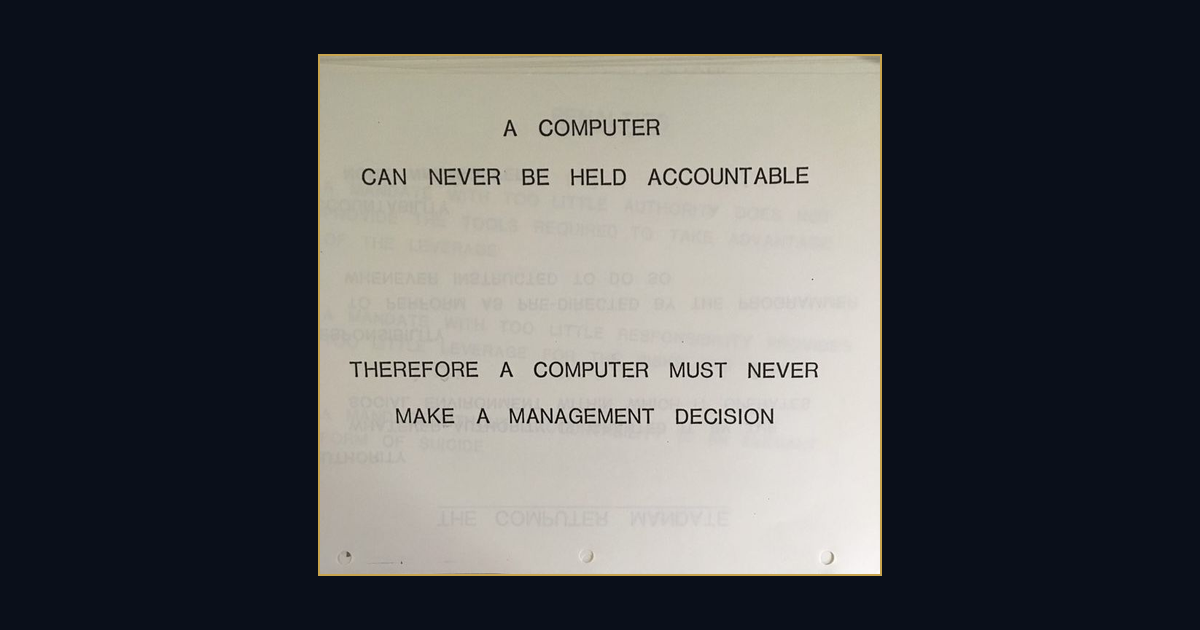
A Computer Can Never Be Held Accountable
In 1979 IBM put up a slide about why a computer must never make a management decision. The hidden text behind the slide shows the argument is sharper than the meme, and that it does not weaken as the models improve.
July 2026

What Closes the Loop?
The big question is whether we can set the agents free and just keep pressing Continue. But that is the wrong question. On why a loop is only as good as it is verifiable, why what closes it is proof and not automation, and why the last gate has to be a human.
July 2026

Everyone Has the Same AI
The model that impressed you this week, anyone can try. On the tool being shared by everyone, the only thing that is yours being your own context, and why the race for the smartest model is the wrong race for a team.
July 2026

Now It's All in One Place
You did the right thing gathering your knowledge into one place. But that means your whole team's knowledge now sits concentrated in one system, and the question of who controls that place suddenly matters. On why ownership and data residency are the precondition, not a checkbox.
July 2026

Ninety-Nine Percent in Your Head
A team writes down almost nothing of what it knows. One percent lives in documents, the rest sits in heads, invisible, fading and on its way to walking out for good. On why what you never wrote down is the real problem, and what it means to get it out.
July 2026

The Rest Goes Stale
A team knows an enormous amount, but what they know together lives nowhere. On why capturing information is the easy part, and why the value is in knowledge being structured and connected into something the team can use again and again, instead of fading inside individual heads.
July 2026

The Layer Nobody Draws
First it was the word intelligence that made us drop our guard. Now it is the picture, the stack drawn as an operating system and the loop that runs itself. On why the architecture diagram is the same trick -- and why the layer it leaves out is a layer of accountability.
July 2026

The Plan Before You Leave the Room
After three years, strategy days and leadership meetings still don't use AI -- not because the tech is hard, but because you get stuck on the wrong question. On getting your own conversation in, keeping the human in the loop, and leaving the room with the action plan instead of a feeling.
July 2026

From onboarded to value
Most organisations that rolled AI tools out to their developers are in the same spot - tools in place, teams trained, but the gains stall. This is what actually happens, and what you can do about it.
July 2026

It's the I in AI That Does It
We call it intelligence, and the word makes us attribute understanding and consciousness the technology doesn't have. The superlatives do the rest. On why the language becomes part of the product -- and why that is a question of accountability.
July 2026

The real project was adoption
We built a carrier-grade calling system with a fraction of the team. The hard part was never getting AI to write code -- it was getting experienced people to change how they work. And that needs a mandate.
June 2026

Give me the insight, not the decision
You don't buy governance by buying licenses. On why the gathering can be automated but the decision cannot -- and what a CAIO actually owns when AI costs run away.
June 2026

What if we'd recorded this?
I sat in a café and talked for fifteen minutes about a concrete problem and a solution. We both know the pipeline. And neither of us hit record. On the gap between knowing and doing.
June 2026

Building got cheap. The bottleneck moved.
Everyone reacts to the speed now -- an app in a day. But building got cheap for everyone, so it stops being what decides. The hard part didn't disappear. It moved -- to people, and to productization.
June 2026

The keystroke is not the measure
We ranked developers by how fast they produced. AI pours out the code now, so the keystroke is a measure that has lost its meaning -- and left the thinking exposed.
June 2026

It works in your Claude
You build something genuinely good in your Claude and think you're almost done. But the client is doing more for you than you realise -- and the distance to a product is nearly all the work that's left.
June 2026

The tech debt you can talk away
The most valuable thing about an old system lives in the head of whoever has lived with it, not in the repo. On turning the voice pipeline backwards -- and talking away tech debt without rewriting a line.
June 2026

Replace or Assemble
A voice in my feed said: don't automate the human things. He is right, but the line runs deeper. The question isn't human versus machine. It is whether the orchestration replaces something you already carry, or assembles something missing from the room.
June 2026

Automation Before Agents
Most people don't trust a free-running AI agent -- they can't control what it does. The ones who win build it the other way around: stable, verifiable steps that an agent is allowed to start on command. Autonomy where it's safe, control where it counts.
June 2026

Same Word, Different Things
Three people can deeply disagree about AI and all be right -- because they mean different things by the same words. Skill, agent, automation. Most of what sounds like a method dispute is really a dispute about words.
June 2026

Coding Faster Isn't Enough
Two shifts are happening simultaneously and both must be handled -- but one makes the other harder. And nobody talks about why.
June 2026

The Impressive and the Billable Are Not the Same Thing
I've been asking people in the industry one concrete question -- have you shipped this to a paying customer? The answer is consistent and tells you something important about the gap between impressive and what actually reaches a paying client.
June 2026

Trust Comes Before the Technology
The real threshold for AI adoption in established organisations is not the technology. It is that no one has had the honest conversation with the leader yet.
June 2026
It's Not the Speed That Kills You
On why speed is not the problem with AI -- and why the crash reveals who actually owns what they built.
June 2026

The Project Was Done. No One Else Understood It.
On what happens when you build a project alone at high speed -- and then try to explain it to someone else. The code works. But the knowledge is stuck in you.
June 2026

Accountability in Three Levels
How carefully do you need to review AI-generated code? The answer depends entirely on which of three levels you're working at -- and confusing them is the most common mistake in AI-assisted development.
May 2026

The Work Loop -- Six Steps That Make Accountability Concrete
Six steps that translate personal accountability from a conviction into a concrete work process. Context management, the inner loop, and why the commit is the final accountability checkpoint.
May 2026

The leader who can't delegate
On why AI transformation cannot be delegated. And what it actually means to own it -- not as an advisor, but as the person responsible.
May 2026

You're not investing in AI -- you're investing in your goals
On why most organizations are asking the wrong question -- and what the organizations that actually succeed do differently. It's not about the technology. It's about what you're trying to achieve.
May 2026

Ninety Percent of the Problems Are AI-Generated
On what happens when a CTO reviews every commit for eight months and discovers that nearly all problematic code is AI-generated. Technical debt doesn't arise despite AI -- it arises because of AI.
May 2026

Each Meeting Alone Drives Nothing
It is not Copilot versus protocol versus handwritten notes. It is all meetings together versus each meeting alone. Loose summaries drive no outcomes. The sum of them can.
April 2026

The Person Who Succeeds with AI Is Not Who You Think
On why the person who gets the most out of AI is not the most technical -- but the one who understands business outcomes. Speed is proven. But speed without direction is just faster waste. The deciding factor is the one nobody talks about.
April 2026

They don’t want to understand — they want to check the box
On why leadership teams don't want to understand AI -- they want to report that they've done something with AI. And why you can actually help with the latter, if you stop explaining the tool and start talking about their people.
March 2026

It doesn’t start with the prompt — it starts with you
On why the most important thing you can do with an LLM has nothing to do with how you write the prompt -- but whether you understood the task before you started typing.
March 2026

Mustaschmilen -- from voice to production
Mustaschmilen reopened March 27 -- for the second year, on a platform that barely resembles the 2025 version. 70+ improvements. From hardcoded to fully configurable. This is what AI-first looks like over time.
March 2026

Messy and crisp
Two words that name something that had no name. On how I calibrate my own input layer -- and why it determines what comes out.
March 2026

My job is the questions
On what happened when I stopped writing instructions to AI and started asking myself questions instead.
March 2026

AI Forces You to Think Harder
On why AI doesn't reduce cognitive load -- it transforms it. And why that's the whole point.
February 2026
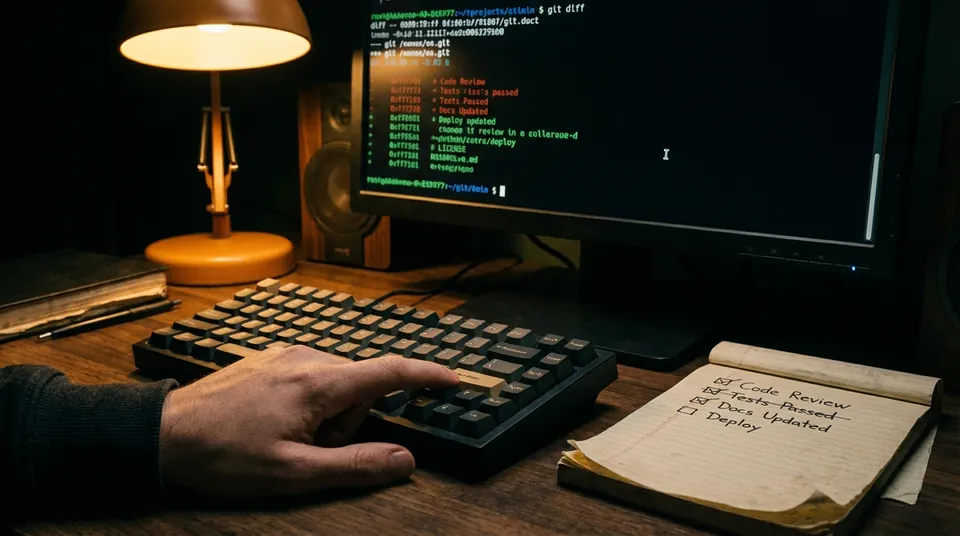
The Checkpoint Is the Job
On why I refuse auto-commits, auto-changelogs, and every form of unsupervised automation.
February 2026
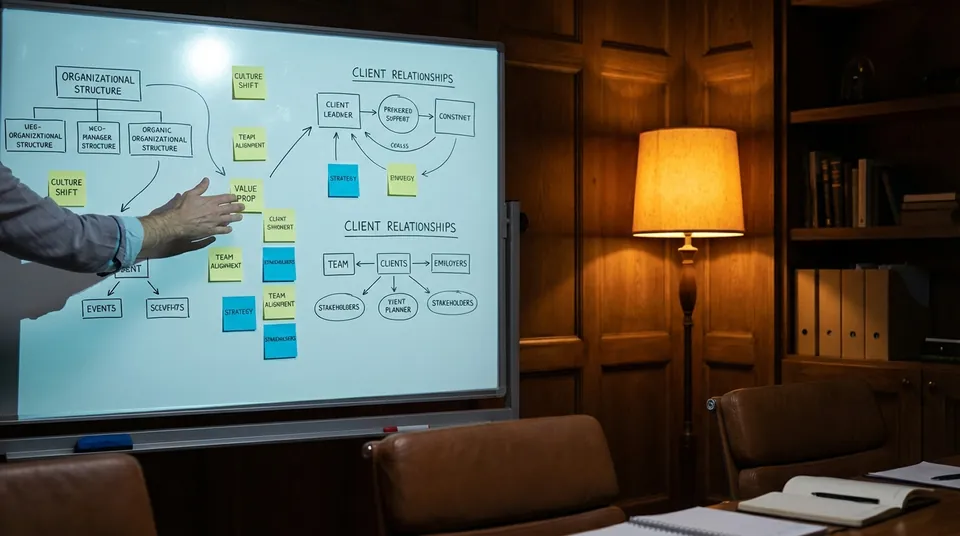
It Was Never a Technology Question
About the time I dismissed a question as magic. And realized neither of us had the answer.
February 2026

From conversation to website
How a 15-minute phone call became a complete website. And why nobody asks how it happened.
February 2026

Text Is Data
Why all professional work is fundamentally about text -- and why that changes the entire picture.
February 2026

One Person, a Thousand Deliveries
How knowledge, chain, and accountability allow one person to deliver what used to require a team -- and why that changes everything.
February 2026

You Can't Validate What You Don't Understand
Why AI amplifies what you already know but doesn't replace what you lack -- and why the hype is dangerous.
February 2026

Three channels, one place
The practical infrastructure for capturing everything that gets said -- online meetings, in-person meetings, and phone calls in the same pipeline.
February 2026

Your Meeting Summary Is Worthless
Why generic AI summaries make the documentation problem worse, and what you should do instead.
February 2026

I Said It a Year Ago
On being early, the limits of context windows, and what happens when the market finally catches up.
February 2026

Everything I Say Ends Up as Text
On voice as raw material, why transcription changes everything, and the why it is still an unusual way to work.
February 2026

I Am Smarter Than AI
On responsibility, judgment, and why the consequence of being wrong makes you smarter than any AI model in existence.
February 2026