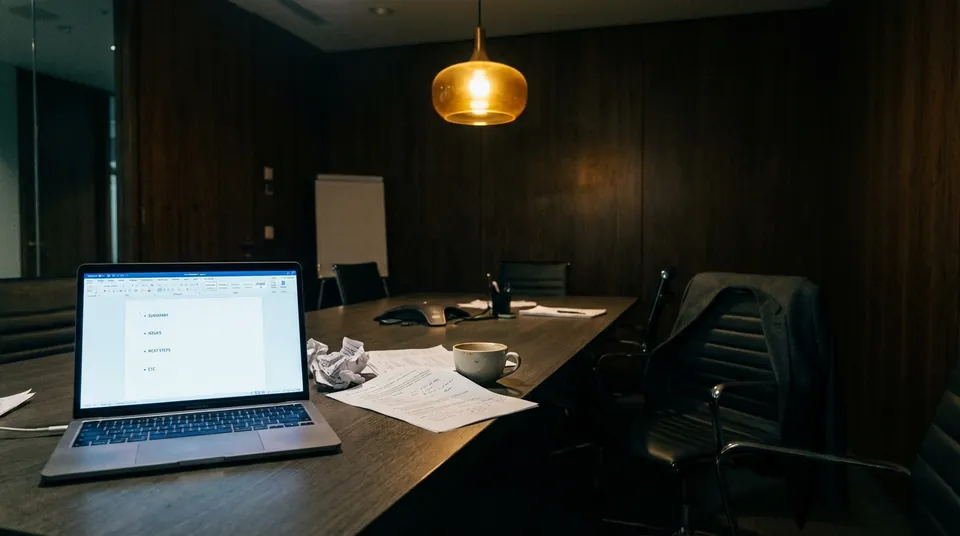
Din mötessammanfattning är värdelös
Du hade ett möte igår. Teams Copilot genererade en sammanfattning. Du skummade igenom den, kanske vidarebefordrade den, och tänkte att mötet var dokumenterat.
Det är det inte.
Det du har är en generisk lista med agendapunkter, namn på folk som pratade, och ett par åtgärdsförslag som låter rimliga men som missar allt som faktiskt avgjorde vad som hände i det rummet.
Och du är inte ensam. Det här är standard nu. Folk accepterar den automatiska sammanfattningen och tror att de har fångat mötet. De har inte fångat någonting.
Vad sammanfattningen faktiskt säger
Den säger att ni diskuterade punkt tre på agendan. Den säger att Maria nämnde budgeten. Den säger att nästa steg är att "följa upp med kunden."
Det låter korrekt. Det är korrekt -- på ytan. Men ytan var inte där det viktiga hände.
Det som faktiskt avgjorde mötets utfall satt i det som röst bär och text inte fångar -- tonen i Marias röst när hon sa "budgeten funkar nog", omformuleringen som avslöjade det verkliga problemet, pausen innan det avgörande svaret. Det var informationen som förändrade förutsättningarna.
Ingenting av det finns i din sammanfattning. AI:n var med på mötet. Den förstod ingenting.
Varför generiska sammanfattningar är farliga
Det hade varit bättre om sammanfattningen inte fanns alls. Då hade du åtminstone vetat att mötet inte var dokumenterat. Då hade du kanske skrivit egna anteckningar, eller ringt en kollega och sagt "vad var det egentligen som hände på det mötet?"
Men nu har du ett dokument. Det ser professionellt ut. Det har rubriker och tidsstämplar och åtgärdspunkter. Det ger dig känslan av att informationen är bevarad. Och den känslan är falsk.
Du fattar beslut baserade på en sammanfattning som fångade strukturen men missade substansen. Du följer upp åtgärdspunkter som låter rätt men som missar vad kunden faktiskt menade. Du förbereder dig inför nästa möte med en version av verkligheten som är tekniskt korrekt och praktiskt oanvändbar.
Det generiska sammanfattandet har inte löst dokumentationsproblemet. Det har gömt det. Folk tror att deras möten är fångade, och slutar anstränga sig för att faktiskt förstå vad som sades.
Vad jag gör istället
Jag fångar hela samtalet. Inte sammanfattningen -- samtalet. Allt som sades, i den ordning det sades, med de pauser och avvikelser och halvfärdiga meningar som faktiskt ingick.
Sedan bearbetar jag transkriptet -- med AI, ja, men inte med en generisk sammanfattningsfunktion som behandlar alla möten likadant. Jag styr vad som extraheras. Jag granskar vad som kommer ut. Jag vet vad som var viktigt i just det samtalet, för jag var där och jag hörde tonerna som text inte fångar.
AI bearbetar. Jag beslutar vad som är korrekt. Det är inte samma sak som att låta Copilot skriva en sammanfattning och acceptera den.
Och sedan bygger kedjan vidare. Förberedelsen inför nästa möte drar från det faktiska transkriptet -- inte från en generisk sammanfattning. Projektspårningen uppdateras med det som verkligen bestämdes -- inte med vad AI:n gissade var åtgärdspunkter. Den dagliga överblicken baseras på vad som faktiskt hände -- inte på en förenklad version av det.
Skillnaden är inte verktyg. Skillnaden är att jag behandlar den verbala konversationen som den rikaste informationskällan jag har. Inte som något som Teams-sammanfattningen kan hantera åt mig.
Den verbala konversationen är underutnyttjad
Det här handlar inte om att Teams Copilot är dåligt. Det gör vad det är designat för -- producera en snabb generisk överblick.
Problemet är att folk stannar där. De tar den generiska överblicken och behandlar den som dokumentation. De investerar i bättre promptmallar, längre kontextfönster, dyrare AI-modeller -- och ignorerar att den rikaste informationskällan de redan har försvinner varje dag för att ingen fångar den på riktigt.
Den verbala konversationen bär det som ingen skriftlig kommunikation bär. Det spontana, det ofiltrerade, det som folk säger utan att ha planerat att säga det. Det är där de verkliga prioriteringarna avslöjas. Det är där relationsinformationen sitter -- den kontext runt kontexten som avgör om en leverans landar rätt.
Och det behandlas som om Copilot kan sammanfatta det i fem punkter.
Det kan den inte. Sluta låtsas att den kan.
Se även: Allt jag säger hamnar i text (serie 2) och Kladdigt och krispigt (serie 14).
Genomlysning-formatet på mindtastic.se bygger på exakt detta -- strategimötet som inte lämnar något spår.